
The Prince Group of Events
The Prince Group of Events
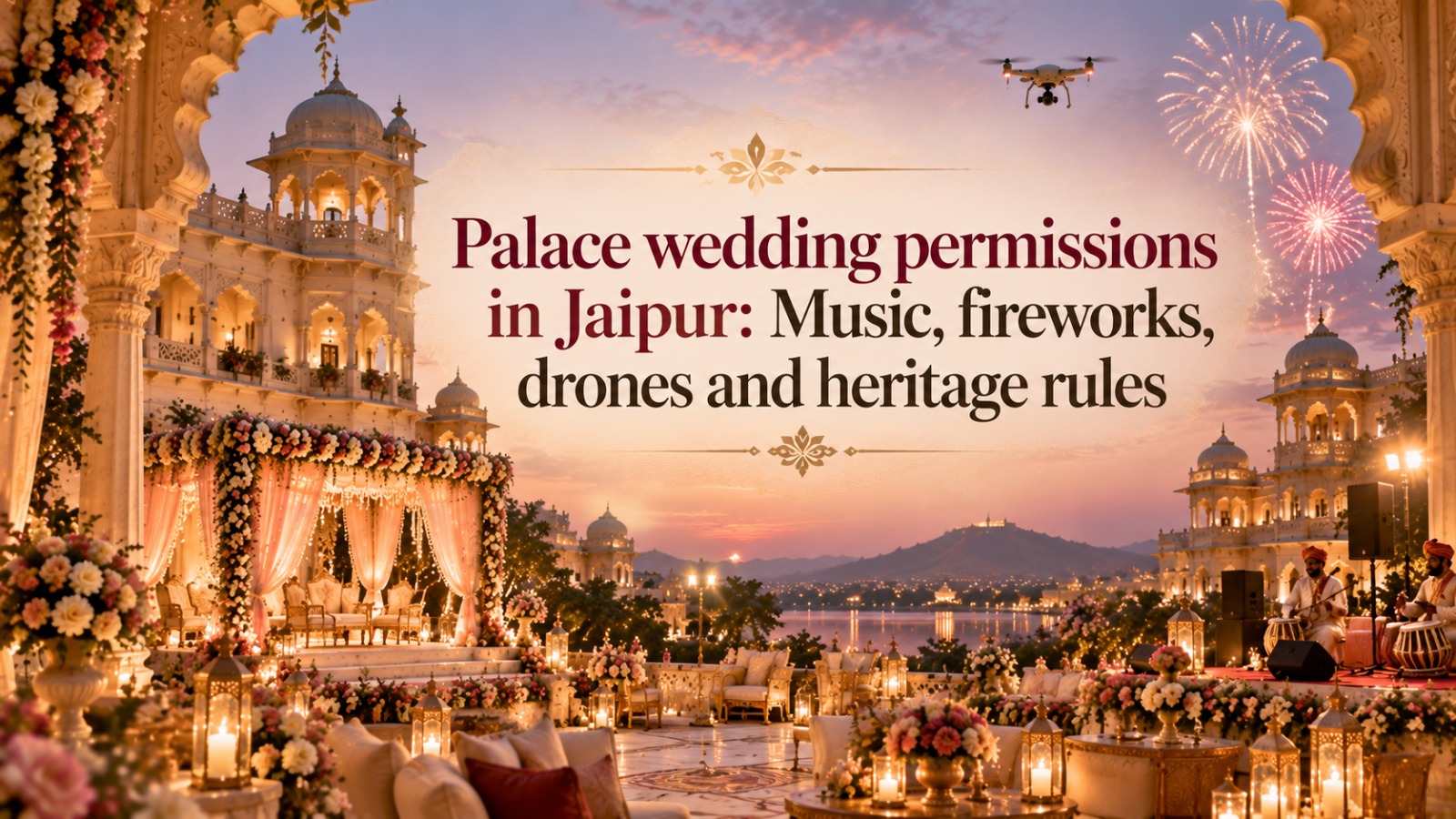
Palace Wedding Permissions in Jaipur: Music, fireworks, drones and heritage rules
A palace wedding in Jaipur may require written approval for amplified music, fireworks, drone photography, temporary structures and certain processions. The exact requirements depend on the venue, event location, airspace category, entertainment plan and local orders in force on the wedding date.
Booking a palace does not automatically give a family permission to use loudspeakers late at night, fly a photography drone or organise a fireworks display. These elements should be discussed before the venue agreement is signed, especially if they are central to the wedding plan.
Read More: How to Book Palace for Wedding
What Permissions may be required for a palace wedding in Jaipur?
A standard palace wedding may involve several approvals rather than one general event licence. Some are handled internally by the venue. Others may need to be obtained through the local police, municipal authority, fire department, aviation authority or another competent agency.
The permission list may cover:
- DJ, live band and amplified outdoor music
- Baraat route and amplified sound during the procession
- Fireworks, cold pyrotechnics and special effects
- Drone photography and aerial filming
- Temporary stages, trusses, platforms and enclosed structures
- Electrical load, generators and temporary wiring
- Fire exits and firefighting arrangements
- Valet parking and guest vehicle movement
The requirements are not identical at every property. A privately managed heritage hotel, an operating luxury hotel and a protected monument can have different approval processes.
Music permission for a palace wedding in Jaipur
Outdoor music is one of the first points families should confirm with the venue. The Noise Pollution (Regulation and Control) Rules require written permission for the use of loudspeakers or public-address systems.
As a general rule, amplified outdoor sound is restricted between 10:00 PM and 6:00 AM. The rules contain limited provisions under which a state government may permit use until midnight on specified festive occasions, subject to prescribed conditions. A private wedding should not assume that this exception applies.
The venue may impose an earlier cut-off, particularly when:
- The palace is close to a residential area.
- The property has other staying guests.
- The event lawn faces guest rooms.
- The venue falls near a silence zone.
- Local police orders impose tighter restrictions.
- The property’s operating licence contains specific conditions.
The national noise rules also regulate permissible sound levels by area and time. Turning down the volume is not always enough if the venue has instructed the production team to stop outdoor amplification completely. Families should obtain the final music cut-off in writing from the venue.
Also Read Best Wedding Entertainment Ideas for Indian Weddings in 2026
What are the music timing restrictions?
Outdoor DJs, bands and amplified speakers should normally stop by 10:00 PM unless a valid written exception applies. The palace or hotel can enforce an earlier deadline.
Music timing should be discussed before finalising the function schedule. If the sangeet is expected to continue late, the planner can examine an indoor ballroom or another enclosed event space. The venue must still approve the proposed setup, capacity and sound arrangement.
A practical schedule could be:
|
Wedding activity |
Planning consideration |
|
Guest seating and dinner |
Begin before the main performance to avoid a delayed programme |
|
Family performances |
Fix rehearsal and stage-call timings in advance |
|
Live artist performance |
Place the main set well before the outdoor sound deadline |
|
DJ session |
Move indoors if the venue permits late indoor entertainment |
|
Sound check |
Complete during the venue-approved daytime window |
|
Production shutdown |
Allow time for announcements and a controlled closing sequence |
An indoor ballroom is not a blanket exemption from all rules. The hotel’s contract, local permission and internal operating policy still apply.
Does a wedding need a separate music licence?
Noise permission and copyright licensing are separate matters.
A Jaipur Police circular issued in 2022 stated that no music licence was required for playing sound recordings at marriages and associated festivities under the marriage-related exception in Section 52(1)(za) of the Copyright Act. That position has been discussed in legal reporting about the Jaipur Police circular.
This should not be confused with permission to use a loudspeaker. A wedding may fall under a copyright exception and still need written approval for amplified sound. Families should ask the venue and planner to verify the current position before signing wedding entertainment or production contract.
Are fireworks permitted at Jaipur palace weddings?
Fireworks are not automatically permitted at Jaipur palace weddings. Approval depends on the venue, local orders, surrounding land use, fire-safety conditions and the type of effect proposed.
Many palace and heritage properties restrict conventional aerial fireworks because of fire risk, falling debris, smoke, noise, animals, nearby vegetation and the possibility of damage to historic surfaces. A venue may refuse fireworks even when a vendor says that the display can be arranged.
Before paying a fireworks vendor, obtain written answers to these questions:
- Does the palace permit fireworks anywhere on the property?
- Which types of fireworks or pyrotechnic effects are allowed?
- Is a police, fire or district-level approval required?
- Must the vendor hold a particular licence?
- What safety distance must be maintained?
- Is a fire tender or additional firefighting equipment required?
Use a properly authorised vendor and disclose the full effect list. The term “cold pyro” does not mean that an effect is risk-free or exempt from venue approval. Spark fountains, confetti cannons, flame units and smoke effects can trigger alarms, damage flooring or conflict with fire rules.
If the palace does not approve fireworks, alternatives may include a coordinated lighting sequence, projection mapping, fountain lighting or a stage reveal. These options also require technical and venue approval.
Can a drone be used at a palace wedding in Jaipur?
A drone may be used only after checking the airspace classification, venue policy, equipment compliance and operator requirements. Permission from the palace alone is not sufficient.
India’s Drone Rules divide airspace into green, yellow and red zones. The operator should check the Digital Sky airspace map shortly before the scheduled flight because restrictions can change.
In broad terms:
- Green zone: Prior airspace permission may not be required, subject to the applicable altitude and any temporary restriction.
- Yellow zone: Permission from the concerned air traffic control authority is required.
- Red zone: Drone operations require permission from the Central Government.
Jaipur has an operational international airport, so the exact palace location and permitted altitude matter. The photographer should never decide that a flight is safe merely because another wedding previously used a drone at the same venue.
Before approving drone photography, check:
- The drone’s registration and Unique Identification Number, where applicable
- The remote pilot’s required certification
- The current Digital Sky airspace classification
- Temporary flight restrictions
- Written permission from the palace
- The proposed take-off and landing area
- Flight height and operating time
Flying directly over a dense gathering should be avoided unless the operation is expressly lawful and supported by a professional risk plan. Palace courtyards can also create difficult flying conditions because of walls, trees, wires, lighting trusses and limited emergency landing space.
Drone planning questions for the photography team
The photography contract should clearly state who is responsible for aviation compliance. Ask the team:
- Which drone and weight category will be used?
- Is the equipment registered where required?
- Who will operate it?
- Has the operator checked the Digital Sky map?
- Does the palace allow take-off from its premises?
- What is the safe flying window?
- What happens if permission is refused?
- Is the aerial shoot included in the package price?
A professional team should be able to answer these questions without vague assurances.
Heritage rules at Jaipur palace wedding venues
A heritage-style hotel and a legally protected monument are not the same. Some Jaipur wedding venues are hotels housed in historic properties, while other locations may contain protected areas or spaces subject to government control.
Rules can apply to:
- Fixing decor into walls, floors or columns
- Drilling, nailing, stapling or permanent attachment
- Suspending heavy installations from heritage structures
- Using candles, open flames or flame effects
- Placing generators close to the building
- Moving antique furniture or architectural objects
- Installing heavy vehicles or cranes in courtyards
- Using adhesive materials on stone surfaces
The production and décor teams should complete a technical inspection before developing the final design. A concept approved through a presentation can still be rejected at the installation stage if its weight, fixing method or power requirement was not disclosed.
Temporary structures and fire-safety approval
Large weddings often use fabricated stages, trusses, covered dining areas, temporary kitchens, generators and decorative electrical installations. These additions can change the safety requirements of the venue.
The production plan should identify:
- Dimensions and load of every stage
- Truss height and suspension points
- Entry and emergency-exit routes
- Fire-extinguisher locations
- Generator placement
- Cable routes and protective ramps
- Material used in fabric ceilings and partitions
- Kitchen fuel and cooking arrangement
A beautiful layout is not workable if it blocks a fire exit or prevents emergency vehicles from reaching the event area. The planner, venue operations team and production contractor should review the same scaled layout rather than working from separate versions.
Baraat and traffic permissions
A baraat that stays inside the palace driveway is different from a procession that occupies a public road. If the route affects traffic, uses amplified sound or requires temporary control of an access road, local police coordination may be necessary.
Jaipur authorities have also examined parking and traffic problems around wedding venues. In 2026, wedding venue operators raised concerns about enforcement of parking requirements and congestion linked to baraat movement. This makes route planning, vehicle holding areas and arrival timing practical issues, not small operational details.
Before confirming the procession, check:
- Whether the route is entirely inside the property
- The maximum permitted duration
- Restrictions on bands, speakers and vehicles
- Horse, elephant or carriage policies
- Animal welfare requirements
- Traffic management outside the main gate
The groom’s entry should have a backup plan in case the original route is restricted on the wedding day.
Who obtains event permissions?
Responsibility should be divided in writing. Depending on the permission, it may sit with the venue, wedding planner, production agency, photographer, entertainment vendor or fireworks contractor.
|
Permission or approval |
Usual coordinating party |
|
Venue approval |
Wedding planner and family |
|
Loudspeaker or sound permission |
Planner, venue or production agency |
|
Drone compliance |
Drone operator or photography company |
|
Palace approval for drone use |
Planner and photography company |
|
Fireworks permission |
Licensed vendor with planner and venue |
|
Temporary stage approval |
Production agency and venue |
|
Electrical and generator approval |
Production agency and venue engineer |
|
Baraat or traffic coordination |
Planner and local operations team |
|
Alcohol-related approval |
Caterer, venue or authorised supplier |
|
Heritage-area restrictions |
Venue management or relevant authority |
“Usual coordinating party” does not necessarily mean legal responsibility. Every supplier contract should state who applies, who pays the fee, who submits documents and what happens if approval is refused.
The family should receive a permission tracker showing:
- Name of the approval
- Responsible party
- Application date
- Required documents
- Current status
- Approval conditions
- Expiry or event date
- Backup plan
When should permissions be discussed?
Permission-dependent ideas should be discussed before the venue contract and major vendor agreements are signed. Formal applications may follow closer to the wedding, but feasibility should be checked at the beginning.
A workable sequence is:
Before booking the palace
Ask about music cut-off, fireworks, drones, outside vendors, décor restrictions, alcohol, parking and procession rules.
Before confirming vendors
Give photographers, entertainers and production teams the venue’s written restrictions. Their quotations should account for those conditions.
During technical planning
Submit floor plans, stage dimensions, electrical loads, effect lists and equipment details.
Before the wedding
Reconfirm all approvals, local orders and Digital Sky restrictions. Share the final conditions with the event team.
On the event day
Keep digital and printed copies of relevant approvals with the authorised on-site coordinator.
Common permission mistakes families should avoid
The most expensive problems usually begin with an assumption. Common examples include:
- Assuming a venue’s verbal approval is final
- Booking a late-night artist before confirming the music cut-off
- Paying for fireworks before obtaining written venue consent
- Treating cold pyrotechnics as ordinary decoration
- Hiring a drone operator without checking the airspace map
- Designing a stage before the technical inspection
- Planning a public-road baraat without traffic coordination
- Forgetting to include permission refusal in vendor cancellation terms
A permission refusal does not have to damage the celebration. It becomes difficult when there is no alternative programme, indoor space or revised production concept ready.
How a wedding planner manages palace permissions
A wedding planner does not replace the government authority or guarantee approval. The planner’s job is to identify the requirements early, assign responsibility, collect documents, coordinate with the venue and vendors, and prepare alternatives.
For a Jaipur palace wedding, this may include:
- Reviewing the venue agreement
- Preparing the event and production schedule
- Coordinating sound-related applications
- Checking fireworks feasibility
- Collecting drone operator information
- Arranging technical inspections
- Preparing vehicle and baraat movement plans
- Tracking vendor documents
This process protects the event schedule and reduces the chance of a last-minute shutdown.
Frequently asked questions
Are fireworks permitted at Jaipur palace weddings?
Fireworks may be permitted at some Jaipur palace wedding venues, but they are not automatically allowed. The venue must approve the proposed display, and additional local or fire-safety permissions may be required. Some heritage properties prohibit aerial fireworks and flame effects completely.
What are the music timing restrictions?
Amplified outdoor music is generally restricted between 10:00 PM and 6:00 AM under India’s noise-control rules. The palace may impose an earlier cut-off. Any exception must be valid for the location, date and event, so it should never be assumed.
Can music continue indoors after 10:00 PM?
It may be possible at some hotels, subject to local rules, venue policy, soundproofing and written approval. An indoor ballroom does not automatically permit unrestricted late-night music.
Does a palace booking include permission for photography everywhere?
No. The booking usually covers specified event spaces. Drone filming, commercial shoots and photography in restricted or heritage sections may need separate written approval.
What happens if an authority refuses permission?
The activity must be changed or cancelled. The wedding plan should include alternatives such as an indoor entertainment programme, ground-based camera equipment or a lighting sequence in place of fireworks.
How early should permission planning begin?
Discuss permission-dependent activities before signing the venue and vendor contracts. Technical documents and formal applications can then be submitted according to the venue’s timeline and the requirements of the relevant authority.
Planning a palace wedding in Jaipur? Share your venue, dates, guest count, event schedule and proposed entertainment with The Prince Events. The planning team can review the operational requirements and coordinate the venue and vendor approval process before production begins.

Recent Posts
Destination wedding in Jaipur for 100 guests: Venue, rooms and cost planning
Mon Sep 21 2026
How to Plan ₹1 Crore Destination Wedding in Jaipur
Fri Sep 18 2026
Jaipur Wedding Venue Buyout: Cost Factors, Rooms and Privacy
Mon Sep 14 2026

NRI wedding planner in Jaipur for couples based in the USA
Sat Sep 12 2026
Share this post
Get In Touch
Company
- About Us
- Album
- Wedding Services
- Real Wedding
Favourite Planner
- Wedding Decorators in Jaipur
- Wedding Venues In Jaipur
Other Links
- Privacy Policy
- Terms & Conditions
- Blog
Contact Us
Plot no. 77, Dhaka Nagar, Maa Anjani Nagar, Jaipur, Rajasthan 302012
Copyright © 2026 All Rights Reserved