
The Prince Group of Events
The Prince Group of Events
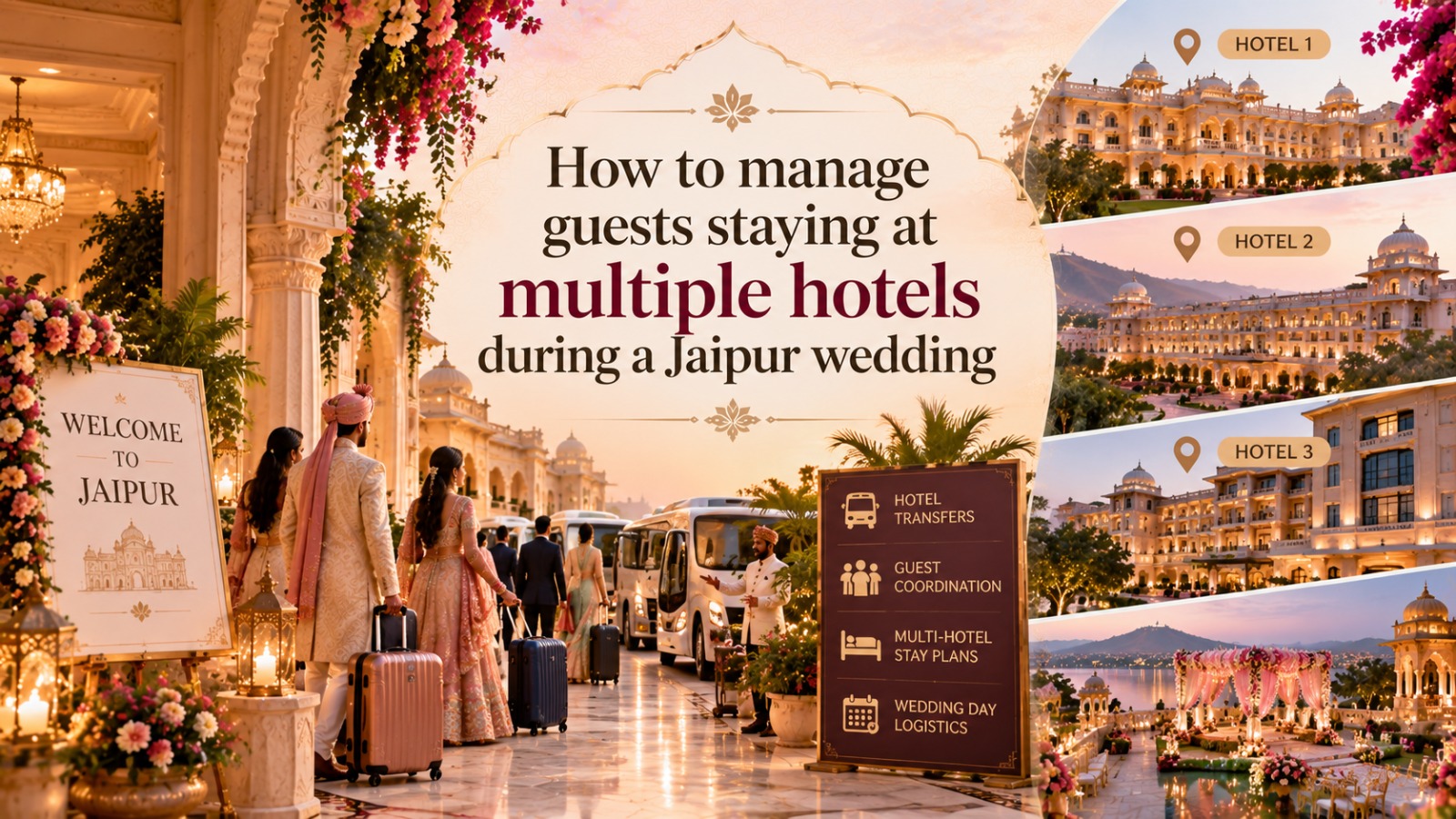
How to Manage Guests Staying at Multiple Hotels During a Jaipur Wedding
Managing guests across two or three hotels is common during a Jaipur destination wedding. One property may not have enough rooms, or the main wedding venue may be too expensive for the entire guest list. The arrangement can work well, but only when room allocation, transport and communication are planned as one system.
The biggest risk is not the distance between hotels. It is the accumulation of small delays. A missing room number holds up luggage delivery. One late bus delays the family photographs. Guests waiting in the wrong lobby miss the baraat departure. A clear operating plan prevents these problems.
Also Read: Destination wedding in Jaipur for 100 guests
Why do wedding guests stay at different hotels?
Families generally use multiple hotels for one of four reasons:
- The wedding venue does not have enough rooms.
- The main palace or resort has a limited number of affordable room categories.
- Close family and elderly guests need to stay near the function spaces.
- Vendors, younger guests or extended family can be accommodated at a nearby hotel.
This arrangement can protect the wedding budget. It can also provide better rooms than forcing every guest into one property with limited inventory.
However, the saving is worthwhile only if the second hotel is reasonably close and the transport plan is reliable. A cheaper hotel on the other side of Jaipur may lead to more vehicles, longer travel times and repeated delays.
Start with the guest list, not the hotel list
Do not begin by reserving random room blocks. First divide the guests according to their relationship, age, arrival schedule and role in the wedding.
A working allocation may look like this:
|
Guest group |
Recommended accommodation |
|
Couple and parents |
Main wedding venue |
|
Immediate family |
Main wedding venue |
|
Elderly relatives |
Main venue or nearest hotel |
|
Families with young children |
Main venue or hotel with easy transport |
|
Close friends |
Main venue or secondary hotel |
|
Extended family |
Secondary hotel |
|
Younger guests |
Secondary hotel with regular shuttles |
|
Photographers and makeup team |
Main venue or nearby hotel |
|
Décor and production crew |
Staff hotel near the venue |
|
Performing artists |
As required by their contract |
Guests who have a role in early-morning ceremonies should stay at the main venue. Moving them from another hotel before sunrise creates unnecessary pressure.
How many hotels should be used?
For most Jaipur weddings, two hotels are easier to manage than three. A third property should be added only when room availability or pricing makes it necessary.
|
Number of hotels |
When it works |
|
One |
Enough rooms are available within budget |
|
Two |
Main property has limited rooms or premium pricing |
|
Three |
Large guest list, separate vendor accommodation or limited inventory |
|
Four or more |
Usually difficult unless the wedding has a large logistics team |
Every additional hotel needs a rooming list, help desk, luggage plan, transport schedule and responsible coordinator. A small saving per room can disappear once extra vehicles and staff are added.
Choose secondary hotels by travel time
Distance in kilometres does not explain how long a journey will take. Jaipur traffic changes according to the area, time of day, tourist movement, market activity and baraat routes.
Ask the planner to test the drive between hotels during the same hours in which guests will travel.
A secondary hotel should ideally be:
- Within 10 to 20 minutes of the main venue
- Easy for buses and larger vehicles to enter
- Equipped with a proper lobby or waiting area
- Able to serve early breakfast
- Willing to support group check-in
- Close enough for an emergency vehicle run
- Clear about bus parking and loading points
A hotel that appears close on a map may have a difficult approach road. Check where coaches can stop and whether guests must walk with luggage.
Prepare one master rooming list
The master rooming list should be the single source used by the family, hotels, hospitality team and transport desk. Separate handwritten lists and WhatsApp messages create confusion.
Include these fields:
|
Guest detail |
Why it is needed |
|
Full name |
Hotel registration and welcome material |
|
Mobile number |
Arrival and transport updates |
|
Family group |
Easier room and vehicle allocation |
|
Hotel name |
Prevents wrong-property transfers |
|
Room category |
Tracks suites, twins and extra beds |
|
Sharing partner |
Avoids room-allocation disputes |
|
Arrival details |
Plans pickup and early check-in |
|
Departure details |
Plans checkout and return transport |
|
Dietary requirement |
Helps hotel and catering teams |
|
Mobility requirement |
Identifies guests needing assistance |
|
Child details |
Helps arrange extra beds and meals |
|
Special notes |
Covers elderly guests, VIPs and medical needs |
Assign one person to approve changes. If several family members edit the list independently, names will be duplicated or removed without notice.
Read More: Destination Wedding Guest Management Jaipur: Avoid Chaos
Confirm the room allocation before guest arrival
Send each guest a clear accommodation confirmation three to seven days before travel.
The message should mention:
- Hotel name
- Hotel address
- Check-in date
- Check-out date
- Room-sharing details, where appropriate
- Hospitality contact number
- First function and reporting time
- Transport departure point
Do not send the complete rooming list to every guest. It contains personal information and can cause further requests for changes.
Create a separate hospitality desk at each hotel
Every guest hotel should have its own help desk during the main arrival window. A single coordinator at the wedding venue cannot solve check-in problems at another property.
The desk should hold:
- Approved rooming list
- Vehicle tracker
- Welcome hampers
- Wedding itinerary cards
- Room keys or check-in status
- Emergency contact list
- List of unresolved requests
For a small hotel block, one experienced coordinator and one assistant may be enough. A busy property with 50 or more rooms will need more support during group arrivals.
Keep the hospitality desk visible. Guests should not have to search for the wedding team after reaching the lobby.
Who handles hotel check-in problems?
The hospitality coordinator should work with the hotel’s front-office manager. Family members should not spend the first wedding day resolving room-key and extra-bed issues.
Common problems include:
- Room not ready
- Name missing from hotel list
- Twin room provided instead of double
- Extra bed not installed
- Guest assigned to the wrong property
- Early-arrival charge dispute
- Luggage sent to another room
- Suite upgrade not recorded
Prepare a short escalation chain:
- Hotel hospitality coordinator
- Senior guest-management lead
- Hotel duty manager
- Wedding planner
Most problems should stop at the first three levels.
Plan luggage separately from passenger movement
Luggage can slow down every arrival. A couple travelling with wedding outfits may have six or eight bags, while an overseas family may carry large suitcases for several functions.
Each vehicle plan should consider:
- Number of passengers
- Number and size of bags
- Outfit trunks
- Gifts and welcome material
- Photography or makeup equipment
A 12-seat vehicle may not carry 12 guests and their luggage comfortably. Use a dedicated luggage vehicle for large arrival groups.
Tag every bag with:
- Guest name
- Hotel name
- Room number, if available
- Contact number
- Family group
Do not send luggage from the airport until the receiving hotel confirms the guest’s allocation.
Build a route-based transport plan
Guests should not call drivers individually. Create fixed transport routes between the hotels and function venue.
For example:
|
Route |
Suggested use |
|
Hotel A to wedding venue |
Immediate family and elderly guests |
|
Hotel B to wedding venue |
Extended family and friends |
|
Hotel C to wedding venue |
Vendors or overflow guests |
|
Jaipur Airport to hotels |
Arrivals grouped by flight time |
|
Wedding venue to all hotels |
Staggered return after each function |
Assign route numbers or colours. The same colour can appear on the itinerary, vehicle sign and hotel help desk.
A guest staying at the blue hotel should look for the blue route. This is easier than expecting everyone to remember vehicle registration numbers.
How many vehicles are required?
The answer depends on hotel locations, guest count and how strictly the functions follow a schedule.
A practical mix can include:
- Coaches for main guest transfers
- Cars for the couple and immediate family
- Dedicated vehicles for elderly guests
- Artist and vendor vehicles
- One or two backup cars
Do not calculate vehicle capacity using the maximum number of seats. Guests wearing wedding clothes need space, and older people may require easier entry.
For a 100-person wedding split across two hotels, two medium coaches or several vans may handle the main movement. Keep a backup vehicle for guests who miss the scheduled departure.
Set departure times earlier than the function time
A wedding ceremony starting at 7:00 PM does not mean the hotel shuttle should leave at 6:45 PM.
The transport schedule must allow for:
- Guests reaching the lobby late
- Boarding
- Traffic
- Security checks
- Walking from the entrance
- Welcome service
A 7:00 PM function may require buses to leave at 6:00 PM or earlier, depending on the route.
Share two times with guests:
- Lobby reporting time
- Vehicle departure time
The bus should depart at the listed time. Holding every vehicle for one guest creates a larger delay at the venue.
Put one transport captain at each hotel
The transport captain checks which guests have boarded, speaks with drivers and reports departures to the central control team.
Their responsibilities include:
- Confirming vehicles have arrived
- Checking route signs
- Counting passengers
- Calling missing priority guests
- Recording the departure time
- Updating the venue team
The driver should not be expected to identify guests or explain the wedding programme.
Use one communication channel for updates
Guests need consistent information. If the family, hotel and planner send different instructions, people will wait in the wrong place.
Use a dedicated guest communication number or announcement group for:
- Airport pickup details
- Check-in information
- Function reminders
- Transport reporting times
- Venue changes
- Weather updates
- Departure instructions
Keep messages short. One useful message is better than five decorative reminders.
Appoint one family representative for each hotel
A hospitality team needs one family contact who understands guest relationships. Staff may not know that an elderly aunt must travel with a particular relative or that two family members should not share a room.
The family representative can help with:
- Sensitive room allocation
- Recognising senior relatives
- Handling last-minute guest additions
- Confirming VIP arrangements
- Resolving family-specific requests
This person should guide the team, not take over routine operations.
Manage elderly guests separately
Older guests should not depend entirely on the main coach schedule.
Provide:
- Rooms near lifts or on lower floors
- Help with luggage
- Early meals where required
- Wheelchairs when requested
- A coordinator’s direct number
- Short walking routes at the venue
- Flexible return transport
If the wedding property has stairs, long lawns or uneven palace pathways, inspect the route before assigning rooms and vehicles.
Plan for families with children
Parents may need extra time before each function. Place families with small children in a hotel that has suitable rooms, easy meal service and a short journey to the venue.
Confirm:
- Extra beds and cots
- Child meal requirements
- Babysitting policy
- Vehicle space for prams
- Early return option
- Access to a quiet room during functions
Do not place every family with children at a distant overflow hotel simply because the rooms are cheaper.
Handle overseas guests with clearer instructions
International guests may be unfamiliar with Jaipur, Indian wedding timings and local transport arrangements.
Send them:
- Hotel address in English
- Planner or hospitality contact
- Pickup meeting point
- Driver information
- Local weather guidance
- Transport departure time
- Basic explanation of wedding customs
- Emergency and medical contact details
A dedicated overseas guest coordinator is useful when many attendees are travelling from the USA, UK, Canada or UAE.
Keep immediate family at the main venue
Parents, siblings and people involved in rituals should stay where most ceremonies take place. Their schedules begin earlier than the general guest programme.
Rooms at the main venue should usually be reserved for:
- Couple
- Parents
- Siblings
- Grandparents
- Makeup artists
- Lead photographer
- Wedding planning heads
- Guests with mobility needs
This is an operational decision, not a status decision. A close relative staying elsewhere may miss a ceremony because the transfer was delayed.
Arrange meals at secondary hotels
Guests staying away from the main venue may need breakfast, tea, drinking water and late-night food at their own hotel.
Confirm whether the room package includes:
- Breakfast
- Early breakfast
- Packed breakfast for departures
- Tea and coffee
- Late-night snack
- Child meals
- Room service
- Drinking water
After a late sangeet, guests may return when the hotel restaurant is closed. A pre-arranged snack counter or limited room-service menu can help.
Coordinate welcome hampers carefully
Prepare hotel-wise hamper counts rather than sending the complete stock to one property.
The distribution list should record:
- Guest name
- Hotel
- Room
- Number of hampers
- Delivery status
- Special gift, if any
Keep extra hampers at each property for late additions or damaged items. Do not place valuable gifts in rooms before the hotel confirms occupancy.
Prepare for room changes and guest additions
There will almost always be changes during the final week. Build a process instead of treating every change as an emergency.
Keep:
- Two or three buffer rooms where the budget allows
- Updated vacancy list
- Extra vehicle capacity
- Spare welcome hampers
- One master change log
Every change should be entered in the master tracker. A WhatsApp message alone is easy to miss.
What happens when a guest misses the bus?
The transport plan needs a late-guest policy.
A guest who misses the scheduled coach may:
- Use the next shuttle
- Join the backup car
- Take a hotel-arranged taxi
- Contact the hospitality desk for instructions
Do not hold a coach full of guests for an extended period unless the missing person is essential to the ceremony.
Share this policy politely before the functions begin.
Return transport needs more flexibility
Guests do not leave a wedding function at the same time. Elderly relatives may return early, while younger guests stay until the end.
Plan staggered departures:
- Early return for elderly guests and families with children
- Main return after dinner
- Late return after entertainment
- Final vehicle for immediate family and organisers
Display return timings at the venue’s hospitality desk. Guests should know whether they need to register for the early vehicle.
Use a central wedding control desk
A central desk should connect all hotels, vehicles and event teams.
It should track:
- Guest arrivals
- Room readiness
- Luggage delivery
- Vehicle location
- Shuttle departure
- Guest count at each hotel
- Unresolved room issues
- Medical requests
- Lost items
- Departure schedule
One senior hospitality manager should have authority to move vehicles and staff when plans change.
Costs to include in the planning budget
Using multiple hotels may add expenses beyond the room rates:
- Additional coaches and vans
- Hospitality staff at every property
- Separate welcome desks
- Luggage vehicles
- Late-night transfers
- Driver allowances
- Staff meals
- Extra signage
- Hotel-to-hotel delivery runs
- Backup cars
- Coordinator accommodation
Compare the total cost, not only the room saving. If the secondary hotel saves ₹1,500 per room but adds a large daily transport bill, the financial benefit may be limited.
Mistakes to avoid
Booking hotels in opposite directions
This makes route management difficult and increases the chance of delays.
Dividing one family group unnecessarily
Parents and children, or elderly guests and their carers, should not be placed in different hotels.
Depending on guests to arrange their own transport
Some will arrive late, get lost or use the wrong entrance.
Using one coordinator for every hotel
The coordinator cannot solve simultaneous check-in problems at separate properties.
Changing room allocations without updating the tracker
This leads to missing hampers, wrong luggage delivery and incorrect vehicle lists.
Hiring vehicles only for full capacity
There will be luggage, wedding clothes, elderly guests and late additions.
Ignoring return transport
Arrival at the function is only half of the job. Guests also need clear options for returning.
Sending too many messages
Long and repeated updates cause guests to overlook the important departure time.
How a Jaipur wedding planner manages multiple hotels
The wedding planner connects accommodation, transport and hospitality rather than treating them as separate services.
The team can handle:
- Hotel room blocks
- Rooming-list preparation
- Guest categorisation
- Airport and railway arrival tracking
- Hotel help desks
- Luggage management
- Shuttle schedules
- Vehicle deployment
- Guest communication
- Special assistance
- Function-wise movement
- Departure coordination
The family should receive a clear staffing and transport plan before the wedding week. “Guest management included” is too broad unless the scope identifies hotels, shifts, staff numbers and vehicle responsibilities.
Frequently asked questions
How do you manage wedding guests staying at different hotels?
Use one master rooming list, a hospitality desk at each hotel, fixed transport routes and a central control team. Every guest should receive their hotel details and shuttle timings before travelling.
How far should the second hotel be from the wedding venue?
A travel time of approximately 10 to 20 minutes is practical. Test the route during the actual function hours because Jaipur traffic can change through the day.
Who should stay at the main wedding venue?
The couple, parents, immediate family, elderly guests and people involved in ceremonies should usually stay at the main venue. Key makeup, photography and planning personnel may also need rooms there.
How many hotels are manageable for a destination wedding?
Two hotels are manageable for most weddings. Three can work with separate teams and routes. Using four or more properties increases staffing, transport and communication requirements.
Should transport be provided between all hotels?
Yes. Fixed shuttles should connect each guest hotel with the function venue. Keep a backup car for elderly guests, emergencies and people who miss the scheduled vehicle.
How are airport arrivals managed for guests staying at different hotels?
The arrival tracker should show each guest’s flight, assigned hotel and vehicle. Drivers and airport coordinators need hotel-wise passenger lists so guests are taken directly to the correct property.
Planning a destination wedding with guests staying at multiple hotels in Jaipur? Share your guest count, venue, room requirement and arrival plan with The Prince Events. The team can prepare hotel allocations, transport routes and an on-ground hospitality plan for the complete wedding.

Recent Posts

Destination wedding in Jaipur for 100 guests: Venue, rooms and cost planning
Mon Sep 21 2026

How to Plan ₹1 Crore Destination Wedding in Jaipur
Fri Sep 18 2026
Palace Wedding Permissions in Jaipur: Music, fireworks, drones and heritage rules
Wed Sep 16 2026
Jaipur Wedding Venue Buyout: Cost Factors, Rooms and Privacy
Mon Sep 14 2026
Share this post
Get In Touch
Company
- About Us
- Album
- Wedding Services
- Real Wedding
Favourite Planner
- Wedding Decorators in Jaipur
- Wedding Venues In Jaipur
Other Links
- Privacy Policy
- Terms & Conditions
- Blog
Contact Us
Plot no. 77, Dhaka Nagar, Maa Anjani Nagar, Jaipur, Rajasthan 302012
Copyright © 2026 All Rights Reserved